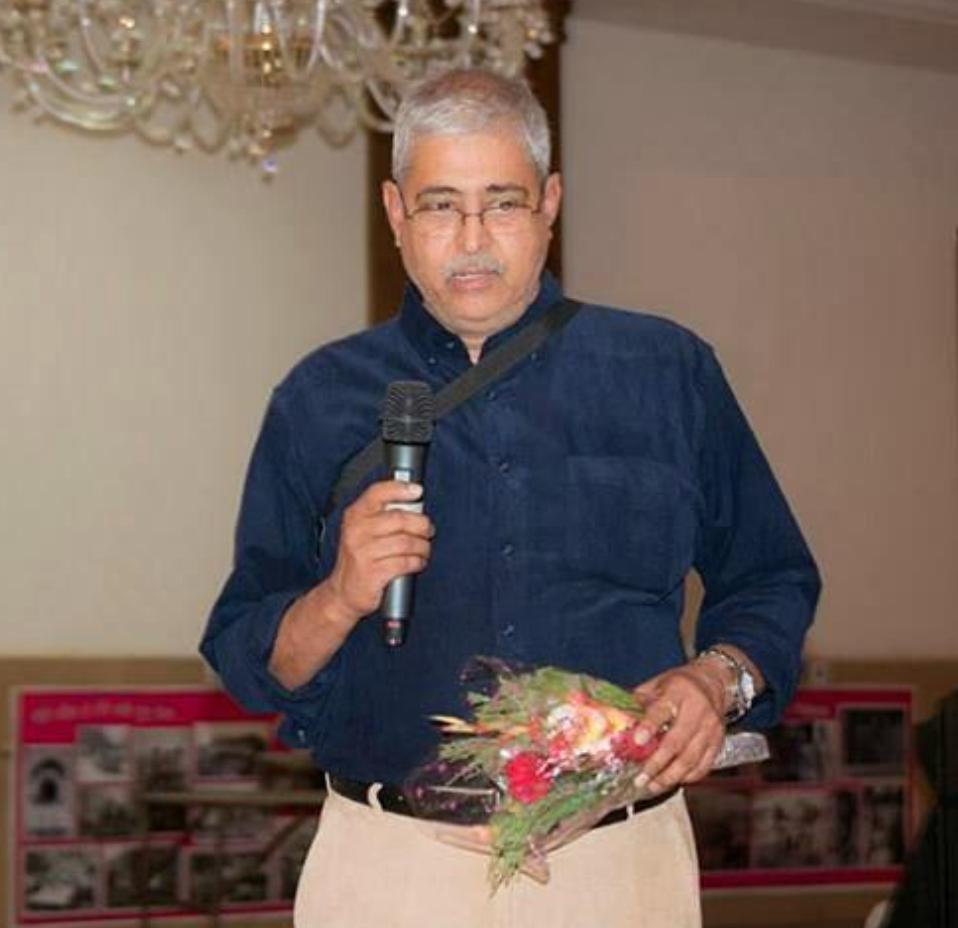
When Vilas Tambe entered his critical care unit, the outside world ceased to exist. “At times I do not see the outside world for weeks,” he once said — not as a complaint, but as a statement of fact, the way a man describes the weather. It is the closest he comes to self-description: the unit, the patient, the problem, and nothing else until it is solved.
The Son of a Doctor
Vilas was born in Nagpur, the son of Dr. Eknath Govind Tambe. His father had earned his Licentiate Medical Practitioner diploma (LMP) from Robertson Medical School, Nagpur, warming the benches alongside the renowned ophthalmologist, Professor Ishwarchandra. The senior Dr. Tambe initially joined Roche as a medical representative before establishing his private practice in Ajni, a stone’s throw from GMC. We, his batchmates from 1973, fondly remember gathering at that clinic during our first year, opening our tiffins to share afternoon lunches.
Vilas himself attended Sule High School for his early education, briefly switched to Hadas High School, and then returned to Sule for the final stretch through to the eleventh standard. For his pre-medical year, he enrolled at Shri Mathuradas Mohota College of Science. He was one of ten students from Mohota to enter GMC Nagpur with us in 1973—a robust cohort that included Harshvardhan Sheorey, Arvind Dani, Rajshree Chaturvedi, Uday Kanhere, C.L. Sonkusare, Sujata Sawangikar, Madhukar Parchand, Surendra Bhandarkar, and Siddhartha Kumar Biswas.
Making a Specialist
He obtained his DA in April 1981, his MD in Anaesthesiology in April 1983—writing his thesis on neonatal anaesthesia under the supervision of Dr. R.K. Pradhan—and cleared the Diplomate of the National Board examination by August 1984. Three formidable qualifications in three years; the accumulation was deliberate.
“Even when I was doing my residency, I worked as a lecturer at GMC,” Tambe recalls with a palpable sense of gratitude. “It was Ramesh Mundle, our classmate, who helped me so much. He taught me ECGs, he taught bedside medicine, and he helped us sharpen our clinical skills. That bedside knowledge served me profoundly during the later years.”
What followed was a period of sustained, wide-ranging clinical training that few anaesthesiologists of his generation could match. He worked in critical care at the Sree Chitra Tirunal Institute for Medical Sciences and Technology in Thiruvananthapuram. He secured a fellowship at Massachusetts General Hospital in Boston, and observed at the Freeman Hospital Regional Cardiothoracic Centre in Newcastle upon Tyne. Each posting added a distinct layer of expertise—the complex neonate, the cardiac surgical patient, the critically ill adult—yielding an education that a man confining himself to a single institution could never have acquired.
After MD, he briefly joined Harkisondas Hospital in Mumbai, coming into close contact with his mentor, Dr. B.S. Singhal. Yet, what Vilas ultimately chose—anaesthesiology and critical care—was not the celebrated specialty in the 1970s that it has since become. The anaesthesiologist was still a largely invisible figure: the technician who simply made the patient sleep so the surgeon could work. Vilas would spend the rest of his career meticulously dismantling that notion.
It was his great fortune that two of the most formidable figures in Indian medicine—Dr. M.S. Valiathan and Dr. B.S. Singhal—took him under their wing. To earn their mentorship was a rare honour, and Vilas absorbed their teachings with characteristic quiet diligence.
Returning to Nagpur, Vilas spent five pivotal years at the Central India Institute of Medical Sciences (CIIMS), building its first critical care and anaesthesiology unit from scratch. There, he had the good fortune to learn neurology from Dr. G.M. Taori and forged a deep friendship with Dr. Mukund Baheti. Before settling down permanently, Tambe spent a few months at Harvard as an anaesthesiology fellow, living close to Vikas Chitnavis, the gastroenterologist from our 1973 batch—a friendship that remains remarkably green today.
In 1993, Tambe and Baheti made the bold decision to leave CIIMS and establish their own practices: Baheti in Dhantoli, and Tambe barely a kilometre away on Wardha Road. Opening its doors in October 1993, Tambe’s Critical Care Clinic became, over the next three decades, one of the most formidable institutions in central India. It was here that he installed the city’s first Puritan Bennett ventilator. He became Nagpur’s first true intensivist, taking on critically ill patients from across Vidarbha—battling snakebites, pesticide poisoning, severe sepsis, pneumonia, and multi-organ failure. Alongside stalwarts like Dr. Shirish Hastak and Dr. Farhad Kapadia, he helped found the Indian Society of Critical Care Medicine (ISCCM). Through it all, he often refused to change out of his surgical greens for days on end, practically living in his ICU—a fact he mentions with characteristic humility.
A Creationist Who Calls a Spade a Spade
The word his colleagues use is creationist — not in any theological sense, but in the sense of a man who constructs solutions where others find only problems. When he began learning anaesthesia, pulse oximetry and end-tidal CO₂ monitoring were new, unproven, and scarce. Anaesthesiologists worked with bags and Boyle’s apparatus. Vilas absorbed what was available, then went looking for the difficult cases — the ones considered too complex or challenging for the private sector — and used his specialist training on them.
He is known for speaking his mind, and not always gently. Incisive, warm, and often fiery, his directness has occasionally converted admirers into critics. He has never adjusted his approach on that account. His colleagues describe his commitment to patient care as incessant; his hands, they say, are gifted.
His daughter Rituja followed him into anaesthesiology — DA from Jawaharlal Nehru Medical College, Belgaum, then DNB, then a fellowship in critical care and a further fellowship at Apollo Hospital, Mumbai. She is married to Ninad Mulay, a prosthodontist. His son Gaurav chose law: LLB, LLM.
His wife Shamal holds an MD in Pediatrics from Pt. Jawaharlal Lal Nehru Memorial Medical College, Raipur — so the Tambe household has produced, across two generations, three anaesthesiologists.
The Unit
Vilas Tambe entered a specialty that, in 1973, many GMC students considered a support role. He spent four decades making the case — not in essays or lectures, but in the unit, in greens, often for days without break — that the critical care physician is not support. He is the last line.
He still operates with, as he once put it, the zeal and enthusiasm of a teenager. The outside world can wait.
“I send greetings from Critical Care, NH 44, Nagpur, which I began in 1993. Work continues, and I try to keep pace.
My mornings start early—with a swim or a cycle ride. The day then finds its own rhythm. In recent years, I have spent some time on small social efforts—visits to an old age home, a few contributions here and there, and helping keep an ambulance service going.
At 71, I do find myself wondering what remains after the routine of practice. The answer, I suspect, lies in these quieter engagements.
Travel and photography have filled the spaces in between. I have been fortunate to see a fair bit of the world. Lately, I spend an hour each day reading about the stock market—more out of curiosity than ambition.
At home, things are settled. My wife, Dr Shamal, continues her work in pediatrics. My daughter, Rituja, is in critical care and anaesthesia in Vashi. My son, Gaurav, chose law and seems at ease with it.
Looking back, a couple of associations have stayed with me—the early days of ISCCM in 1993, and ISA Nagpur since 1987.
Life, as it stands, is simple, occupied, and, on most days, quietly satisfying.”