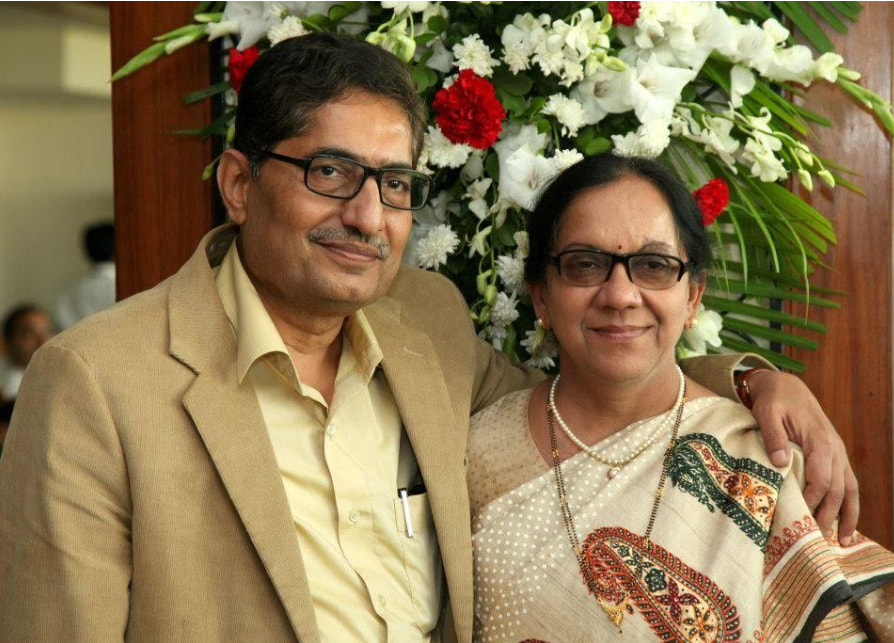
The fortress of the ladies’ hostel, as Deepak Bahekar would discover in 1976, was not entirely impregnable — if you painted well enough. He sent portraits inside. Alka Mehta sent nothing back, at first. But she read the books Deepak recommended. She listened. And four years later, on 23 June 1980, the two married in Mumbai, both mid-qualification, both headed for a life in medicine — and eventually, together, to Gondia, where they would build one of the most respected obstetric and surgical practices in the region.
A Family Built for Something Larger
Alka was born in Belgaum, Karnataka, into a family whose roots ran in two directions simultaneously: education and resistance. Her father, Omprakash Mehta — MSc, LLB, Punjabi, Communist, member of Forward Block — had personally escorted Subhash Chandra Bose to Germany during the Second World War. Her mother, Padma Mohgaonkar, was a Maharashtrian Brahmin, a poet, and the daughter of an Income Tax Commissioner; she rose to become Joint Director of Social Welfare.
That parentage — the militant father, the literary mother — produced a daughter with an instinct for precision and a quiet determination to excel. Alka attended St. Ursula High School, Nagpur, then spent two years at Sanjivan Vidyalaya, Panchgani, returned to St. Ursula for the tenth standard, and completed the eleventh at Saraswati High School, Nagpur. Her premedical year was at the Institute of Science, Nagpur.
She entered Government Medical College, Nagpur in 1973.
Two Qualifications, One City, One Decision
The courtship that began in 1976 survived the particular difficulty of being conducted across hostel walls, through painted portraits and borrowed books, in the compressed social world of a medical college where everyone knew everyone’s business. When Alka and Deepak both sat the Nagpur postgraduate entrance examination and both received seats, the decision about where to train made itself.
After her internship, Alka had gone to Mumbai, working house jobs in surgery and gynaecology and registering for the DGO. The PG seat at Nagpur brought her back. She completed her MD (Obstetrics and Gynaecology) in 1983, her thesis on induction of labour supervised by Dr. Shastrakar. Deepak completed his MD in Medicine. They married between qualifications and left for Gondia together.
In Gondia, they spent a few months at the district hospital as medical officers before opening Bahekar Nursing Home. Alka ran the obstetric and gynaecological practice. Deepak ran the medical one. Over the next four decades, the nursing home grew into Bahekar Hospital and ICU — a full inpatient facility on Govindpur Road, Civil Lines.
Ten Thousand Births
The number that defines Alka’s practice is 10,000. That is the number of births the obstetrics department at Bahekar Hospital has recorded under her care across four decades — a figure that encompasses routine deliveries and complicated ones, normal labours and surgical interventions, women who came from Gondia itself and women who came from districts away because her reputation had reached them.
She has been, by the account of those who trained under her, a perfectionist and a teacher — studious, exacting, and quietly demanding of those around her. She has spoken at local and national continuing medical education programmes; she has stayed current with a field that has changed considerably since she trained.
Her three children all stood first in the state board at matriculation. All three became doctors. Anupama — MBBS from GMC Nagpur, fellowship in cardiology from Bengaluru — is married to Dr. Sathya Kakade, a senior vitreoretinal surgeon. Anushree — MBBS from G.S. Medical College and KEM Hospital, Mumbai; MD Anaesthesiology from PGIMER Chandigarh — is married to Dr. Abhijeet Chaudhari. Anurag — MBBS from Topiwala National Medical College, Mumbai; MD Medicine, MY Hospital Indore; DM Cardiology — is married to Dr. Gargee Pandit, an obstetrician and gynaecologist from G.S. Medical College and KEM Hospital, Mumbai.
A family of doctors producing a family of doctors: the logic is not accidental. It is what happens when two people build a practice around the conviction that medicine is worth doing well, and raise their children inside that conviction.
The Portrait That Worked
Deepak Bahekar used his portraits to breach a hostel wall. What he could not have known in 1976 was what would follow: not just a marriage, but a four-decade practice in a town in eastern Maharashtra, 10,000 births, three children who became doctors, and a hospital that bears their shared name. The painting, it turned out, was the least of what he had to offer. And Alka, it turned out, had known that early.