I always called her Jiji; her first name never seemed to fit the space she held in my life. Pushpa, my second elder sister, was born on May 17, 1946—fifteen months before India stepped into independence. She was the third of six siblings, all born within the familiar walls of our home in Marwadi Mohalla, Wardha. All, that is, except me.
Between my sister Asha and me, Jiji held a place that felt natural and could not be replaced. She was eleven years older, and to me she was both a companion and a guide. Our eldest sister carried the authority of a second mother. Jiji was different. She was steady, always there. I turned to her without thinking, through every phase of my life.
She studied in Marathi-medium schools in Wardha—Sarkari Madhyamik Shala, Kesrimal Kanya Shala, and Craddock High. In Class 10, she and our brother Ashok were in the same class. I still remember the story of their Physics exam. Jiji came out in tears, sure she had failed. Ashok was calm and confident. When the results came, she had passed. He had not.
At that time, she wanted to study science and become a doctor. The dream did not break with drama. It was set aside quietly. A local professor advised our father that a medical career would delay her marriage and limit her prospects. My father chose what seemed practical then. Jiji did not argue. She accepted it. Science gave way to Arts, and her chance at a life in medicine slipped away, almost without a sound.
She married Shri Tarachandji Chandak in May 1965. She tried to continue her studies at Yashwant College, but a new household has its own pull. Travel, responsibility, and daily work took over. Soon after her final exams, and the birth of her daughter Mamta, her formal education came to a quiet end. Life moved on.
As a girl, she was full of energy. She loved Kho Kho, Langdi, and relay races. That spirit stayed with her. I remember once we were playing Gulli Danda when her father-in-law arrived without warning. Our mother, worried about what people would say, called her inside. Jiji slipped out through the back door and, within minutes, was seen busy with housework, as if she had never stepped out. That was her way. She found a balance between what she was and what was expected of her.
Her married life took her across the country—Madras, Nagpur, Kagaznagar, Baroda, Gwalior, Indore. Each move meant starting again. She built a home each time, from very little. For years, she carried this without complaint, making sure her children never felt the strain.
During my medical years in Nagpur, her home in Shankarnagar became my refuge. I went there almost every weekend. The house was always full—relatives, children, noise—but Jiji moved through it calmly. She cooked, served, and somehow made space for everyone. We played cards late into the evening. On Monday mornings, her children would hide my cycle keys, trying to keep me there just a little longer.
We wrote to each other every week. Her postcards were simple, filled with small details of her day. Once, when I did not reply, she wrote asking if I had stopped writing because she was poor—whether I still cared for her. I read that line in my hostel room and felt its weight. I wrote back at once. That was Jiji. She never asked for much, but she held on to her relationships in a way that left no room for doubt.
In the late eighties, when times were hard, she began to work. She sold salwar suits from her flat in Indore, traveling to Delhi and Gandhinagar to bring back material. Where her husband could act on impulse, she held things together. She carried the strain quietly, without complaint.
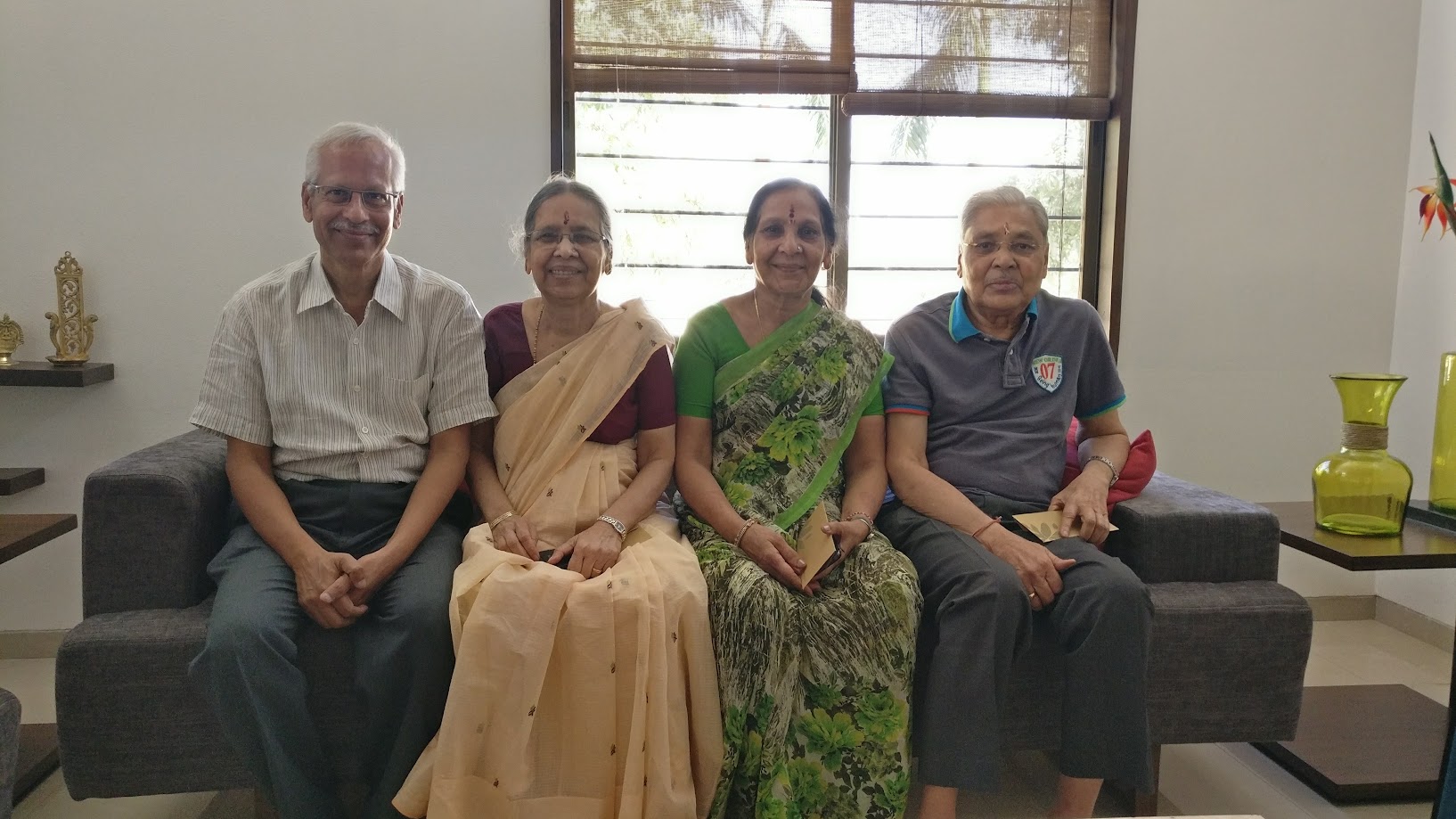
In January 2020, Jijaji fell ill in Pune. When the family spoke about withdrawing life support, she listened quietly. She understood what was being said. There was no visible turmoil, only a calm acceptance of what lay ahead. He passed away before any decision had to be made.
Her own illness had begun earlier, in the winter of 2018, with ovarian cancer. She went through surgery and chemotherapy without seeking sympathy. When the disease returned in 2022, she faced it in the same way—quietly, with resolve.
The Circle of Care
Her final years were held together by a small, steady circle of care. At its center were Aalok, her sister’s son, and Archana, her daughter-in-law.
Aalok never let distance come in the way. A phone call was enough. He would arrive soon after. In hospital corridors, he spoke to doctors, handled the paperwork, and stayed by her side. He sat through long chemotherapy sessions, lightening the mood with small jokes and finding simple ways to ease her discomfort. Jiji waited for his visits. Yet, he would never take even a glass of water from her home.
At their second-floor modest flat in Kanchanhar Enclave, life had grown quieter. After her granddaughter Sakshi left for the United States, only three remained—Jiji, her son Manoj, and Archana. It was here that care became part of daily life. Archana managed everything without fuss—appointments, medicines, the endless trips to the pharmacy. As the illness progressed, she did what she could to keep Jiji at home and comfortable.
She would sit with her during meals, urging her to eat a little more. On long afternoons, she stayed by her bedside, her hand resting gently on Jiji’s. It did not feel like duty. It felt like affection. Jiji often told me she was fortunate to have an “angel” at home.
And then there was Manoj.
Years ago, he had bought this flat and put it in her name. He never spoke much about such things, but the gesture stayed. He was not someone who showed his feelings easily. Watching her grow weaker, day after day, unsettled him in a way he could not quite handle. The hospital—the chemotherapy sessions, the waiting, the slow drip of suffering—was something he did not have the nerves for.
So he asked Archana to take his mother for her chemotherapy, to sit by her bedside, to be there through those long, difficult hours. She became the one who went to the hospital, to the pharmacy, for scans, for procedures—she stayed close to Jiji through it all.
Manoj held everything else.
People often misunderstand such choices. They see absence, but not what lies behind it.
He made sure her treatment never paused, that every expense was taken care of, that nothing she needed was ever out of reach. He dealt with the decisions, the arrangements, the constant demands outside the home. If Archana stood by Jiji through the illness, Manoj stood guard over everything that made that care possible.
His way of caring was quiet, but it did not falter.
In those years, without ever spelling it out, the two of them found their places—she beside Jiji, he holding the world around them steady. And between them, they made sure she was never alone.
The Two Voices
I lived those years in two roles: the younger brother she loved, and the doctor she trusted. We spoke many times each day. When the pain grew, she would call, and I would listen. Often, that was all she needed. She had a simple faith in me. She would tell others that my medicines always worked. She trusted my judgment more than that of her oncologists. If I suggested a scan, she agreed without question.
I am a physician, not a gynaecologist, and I knew little about how ovarian cancer behaves. But her illness—her scans, her blood tests—pushed me to read. I read whatever I could find and, over time, grew more familiar with the chemotherapy regimens and with a few supportive medicines that could ease her symptoms—help her eat, feel less tired, and sleep better.
Once, I suggested a medicine to be taken an hour before chemotherapy. It seemed to abolish her nausea, and she was pleased. She would sometimes say, with quiet satisfaction, that it helped when other treatments had not. I took it simply as a small relief in a difficult journey.
Yet the reading brought with it a deeper unease. As I began to understand the course of the disease, it became clear that her time was limited, and that no intervention—however well meant—could change that truth.
The hardest time came when treatment could no longer help. During her visits to Sevagram, we spoke often about the end. She was clear in her mind. She did not want a long life at any cost. She wanted a life without pain. As she became confined to her bed, I had to tell her the truth—there would be no more scans, no more chemotherapy. We would focus on comfort.
She accepted it without resistance. In those months, she taught me more than any textbook could. I saw what palliative care truly means, not in a hospital, but at home. Through her, I understood how dignity is kept, even at the end. And how, even then, I could remain her brother while speaking as her doctor.
The Final Order
As the end came closer, the illness slipped out of our conversations. We spoke of the past instead—of places we had lived in, people we had known, and small shared memories. A year before she died, I spoke to her about a living will. I told her that when she could no longer speak, this would speak for her—no ICU, no machines, a death at home. These were not easy conversations for me. But I felt it was better to be honest than to offer false hope.
In her last days, she spoke less, slept more, and ate very little. She was tired all the time. A dull, constant pain stayed with her. Her walks to the neighbourhood garden became short strolls inside the house, and then, slowly, she could not even turn in bed.
Our last video call was the day before she died. She opened her eyes, recognized me, and then closed them gently. That night, memories came in waves. I felt my eyes fill with tears. As a doctor, I see illness and suffering every day. But this was my sister. That distance was gone.
On the morning of March 22, 2026, Aalok called. I could sense it in his voice even before he spoke. She had passed away at home, just as she had wished—quietly, without struggle, without machines.
Only later did I learn how carefully she had thought about these last moments. Six years earlier, she had chosen a photograph she liked and asked her grandson, Sarang, to keep it safely. Six weeks before her death, she told him that this was the photograph to be used. She was clear about the details. No marigolds—she never liked them. No white jasmine. She wanted roses. And she did not want silence; she asked for a band for her final journey.
Even at the end, she arranged things in her own way. When I think of her now, I do not see the illness. I see the homes she built, the letters she wrote, and the quiet way she held all of us together. All my life, I called her Jiji. That is how she stays with me.
Simply superb. It proves once again that the pen is mightier than any other form of expression! 👍👍
Masi has left us.
She was deeply loved and very close to our hearts. This truly feels like the end of an era. Though she had been unwell, she fought bravely, overcoming many health challenges. And now, as life takes its natural course, we must accept that she has moved on to her onward journey… until we meet again.
Such is the reality of life.
One thing we should always remember — the passing of a family member becomes a powerful unifier. Irrespective of status, time, age, or location, it brings everyone together. Without question, people come forward with their time, their presence, their prayers, and their support.
Such is life… it unites us in moments of sorrow, just as it does in moments of joy.
These moments remind us that there is a Supreme force above us — God. It is a time to pause, to reflect, and to feel gratitude for that divine power. 🙏
Jai Shri Krishna 🙏
Respected Mamaji, you have beautifully penned down her life journey. 😌
She was truly a great person with a beautiful soul. 🙏
Well expressed. I have read this so many times and it brings me to tears every time. Thank you for being there for Mummy during her hardest moments. I will always follow her instructions and honor her memory
Lucid, elegant and simple – that’s the way you conveyed. Thank you for this, I knew her only a little.
Pranam S P Mamaji, this is such beautiful expression of your deep soul connection with Badi mummy! Through this you have truly celebrated her being and unravelled a side of her I did not know of. Not just for her but for all of us you are a pillar of strength, a fall back net and most of all someone we can place our trust in! Thank you for being there always 💕🙏
Bhabhiji always loved and cared for me like her own son-in-law. She truly knew how to maintain love and harmony in the family. 🌹🙏
I deeply admire your love and care for your sister. Not just as a brother, but also as a doctor.
I have great respect for you as a noble person.
God bless you. 🙏
Very touching write-up. The bond between SP, as Masi called him, and Jiji, as Mama has described, comes through so beautifully. I could even sense the words left unspoken.
The day before, when I heard that Alok had gone to see Masi, a thought crossed my mind that she might not be with us much longer. I prayed for her because I had heard how much pain and mental trauma she was going through, and there was no assurance.
The signs of recovery had faded.
The next morning, there was a deep calm. I loved her because she was like a mother to me. We used to go together for matinee shows in Nagpur, travelling by rickshaw.
When Maa was in Sevagram, Masi stayed by my side. She made me attend painting classes and kept me engaged, even though everyone was busy with Maa.
The two sisters shared a lively bond and spoke every day. I do not know how Maa will overcome this loss.
I will miss the happiest moments of my childhood with her. Since her ordeal with cancer, I always made sure to meet her and often visited Indore because of her.
The last lunch we had together was in February. After coming from Wardha, I went to Indore to see her. Such a strong person seemed a little shaken, but her ever-smiling daughter Archana cared for her in a way that words cannot describe. Archana looked after everything. She listened to her, understood her, and cared for her more than anything else in the world.
Masi, you had a beautiful life. You taught us that with strength and dignity, one can live fully and joyfully, no matter what illness comes.
I still remember your laughter whenever Sanika called you. It feels nostalgic, and yet I am relieved that you are finally free from pain.
Stay with us always, in our memories.
May those memories never fade. 🌹
Extremely Heartwarming. Got tears in my eyes.
Kakiji always felt blessed to have a brother like you by her side 24*7.
प्रिय श्रीप्रकाश बाबु,
जय श्री कृष्ण।
आ.भाभीजी के महाप्रयाण से हम सब शून्य में आ गए ,
इस दु:खद घड़ी में परिजनों के अपनत्व और आत्मीयता भरे भावपूर्ण शोक संदेश इस कठिन परिस्थिति से उभरने के लिए हम सब के लिए वरदान है।
पूज्य भाभीजी का
संघर्ष मय जीवन अच्छे एवं चुनौती यो दिनों से भरा रहा! परन्तु
अपने संस्कार एवं संस्कृति से समझौता न करते हुए, परिवारकी परंपरा, प्रतिष्ठा एवं संप्रभुता को बनाए रख कर शिखर पर पहुंचाने
में अपना अमूल्य योगदान दिया। आज पूज्य भाभीजी हम बीच नहीं है, लेकिन उनके उपस्थिति का अहसास हम हर पल, हर जगह, हर कोने में, हर परिस्थिति में कर ते रहेंगे, उनसे आशीर्वादित होते रहेंगे!
अपना दायित्व निभा ते हुए, मनोज एवं अर्चना ने अंत तक पूज्य भाभी जी की सेवा करते हुए आ. भाभीजी विचारों और आदर्शों को आत्म साथ किया। अतुलनीय, प्रशंसनीय एवं अनुकरणीय है हम सब के लिए।
आप पूज्य भाभीजी के केवल भाई ही नहीं थे, एक विश्वनीय मित्र भी थे! चिकित्सक के रूप में
आप को देवता स्वरूप मानती थी! समस्त चांडक परिवार आप को नमन करता है!
पूज्य भाभीजी को हमारा शत शत प्रणाम एवं भावपूर्ण श्रद्धांजलि,🙏
प्रभु से प्रार्थना, दिवंगत
पुण्यात्मा को अपने चरणों में स्थान दे कर चिर शान्ति प्रदान करे!
नंदलाल – मंजुश्री
🙏🙏 I listened to the conversation between you and Ma. I am deeply saddened by her passing, yet relieved that her suffering has come to an end. Born on a Monday, and her last rites also on a Monday—it feels poignant. Her fighting spirit will always give us strength to face and ease future pain. We will love her for eternity. With tearful hearts, we bid her a farewell to her eternal abode. 🙏🙏