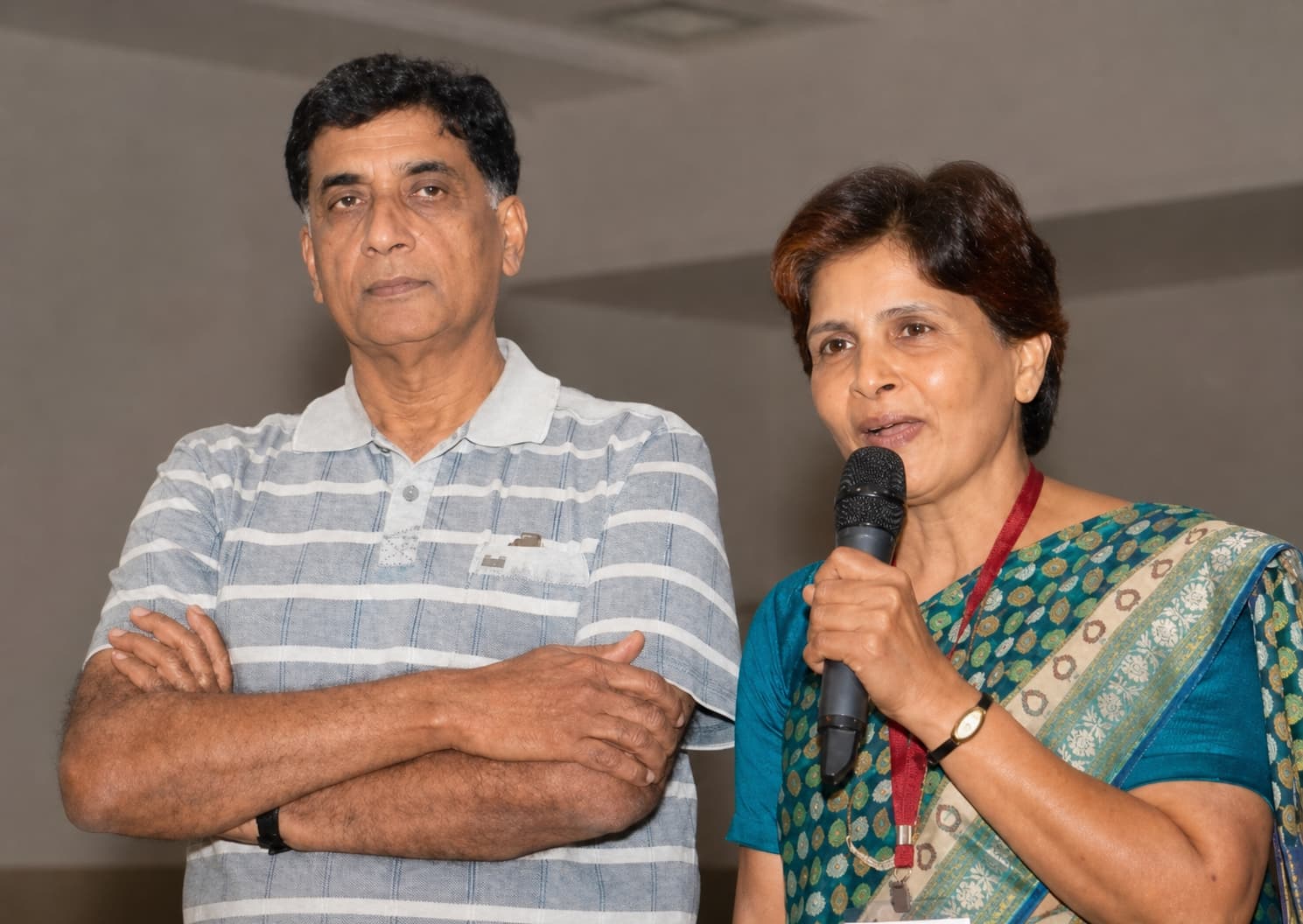
In May 1987, Sunita Jain opened the first private nursing home in Dhamtari, a town of some eighty thousand people situated 85 kilometres southwest of Raipur, in what was then Madhya Pradesh and is now Chhattisgarh. There was no competition to worry about. There was also no template to follow. She built the practice on her own terms, patient by patient, delivery by delivery, through years when the nearest referral centre was an hour’s drive away and the decision to operate often had to be made on judgment alone.
From Nagpur to Dhamtari
Sunita was born in Ahmednagar on 16 October 1956. Her father was a science graduate; her mother a homemaker. Two of her sisters also entered medicine. The family was rooted in Nagpur, where Sunita attended Mount Carmel School for her primary and secondary education and Saint Joseph’s Convent for her higher secondary. She completed her pre-medical year at Dharampeth College, Nagpur — in a cohort that included Sudhir Sathe, Vinayak Sabnis, Ashok Badhe, Khemraj Wankar, and others who would join GMC in the same 1973 batch.
At GMC, her close friendships — Vijaya Vithalkar, Vijayalaxmi Kane, Anjali Sapkal, Aruna Gattani, Sandhya Mohgaonkar — formed a particular circle among the girls from small Vidarbha towns who had arrived at a college where convent-educated English speakers seemed to have the advantage. After the first MBBS, Sunita recalled, they discovered that the advantage was temporary. Competence, it turned out, was portable.
She interned at GMC Nagpur and at the Rural Health Unit and Training Centre, Saoner — where, as was the practice in those years, all women from the batch were posted for their rural rotation.
Obstetrics by Dr. Meena Deshmukh
In February 1979, Sunita married Dr. Suresh Jain, a general practitioner from Dhamtari. She moved to a new town, a new state, a new life. She pursued her DGO through GMC Nagpur, completing it in November 1981. Her teacher was Dr. Meena Deshmukh, under whom she learned the fundamentals of obstetrics and gynaecology — the kind of formation that produces clinicians who handle complications without losing composure, because they learned from someone who never did.
For two years after her DGO, Sunita worked at Dhamtari Christian Hospital, learning the terrain, building trust among patients who had not yet decided whether to trust her. Then, in May 1987, she opened her own maternity nursing home. The first private one in the town. By the time Chhattisgarh separated from Madhya Pradesh in 2000 and Dhamtari acquired the status of district headquarters, Sunita Jain’s practice was already a fixture — the place women went when they were pregnant, or anxious, or needed someone who had seen everything and remained steady.
Two Generations of Dentists
For nearly four decades, Dhamtari has been home. The family lives above the clinic — a particular kind of life, where professional and domestic time share the same rooms and the doorbell is never entirely off-duty.
Both sons entered medicine, and both chose dentistry. Vivek completed his MDS and practises in Dhamtari; his wife Priyanka coaches commerce students in the town. Vaibhav completed his MDS from Annasaheb Chudaman Patil Memorial Dental College, Dhule, and is an associate professor at Chhattisgarh Dental College and Research Institute, Rajnandgaon. Both have children — Shubhi and Samar belong to Vivek’s household; Vikrant to Vaibhav’s.
Sunita herself remains the lone gynaecologist of the GMC 1973 batch in Chhattisgarh — she and her batchmate Madhushree Madhankar-Deshpande, a paediatrician at Bilaspur, were for years the only representatives of the class in this state. It is a reminder of how thin the distribution of trained specialists was, and still is, across the smaller cities of central India — and of how much difference one person in the right place, staying for the long term, can make.