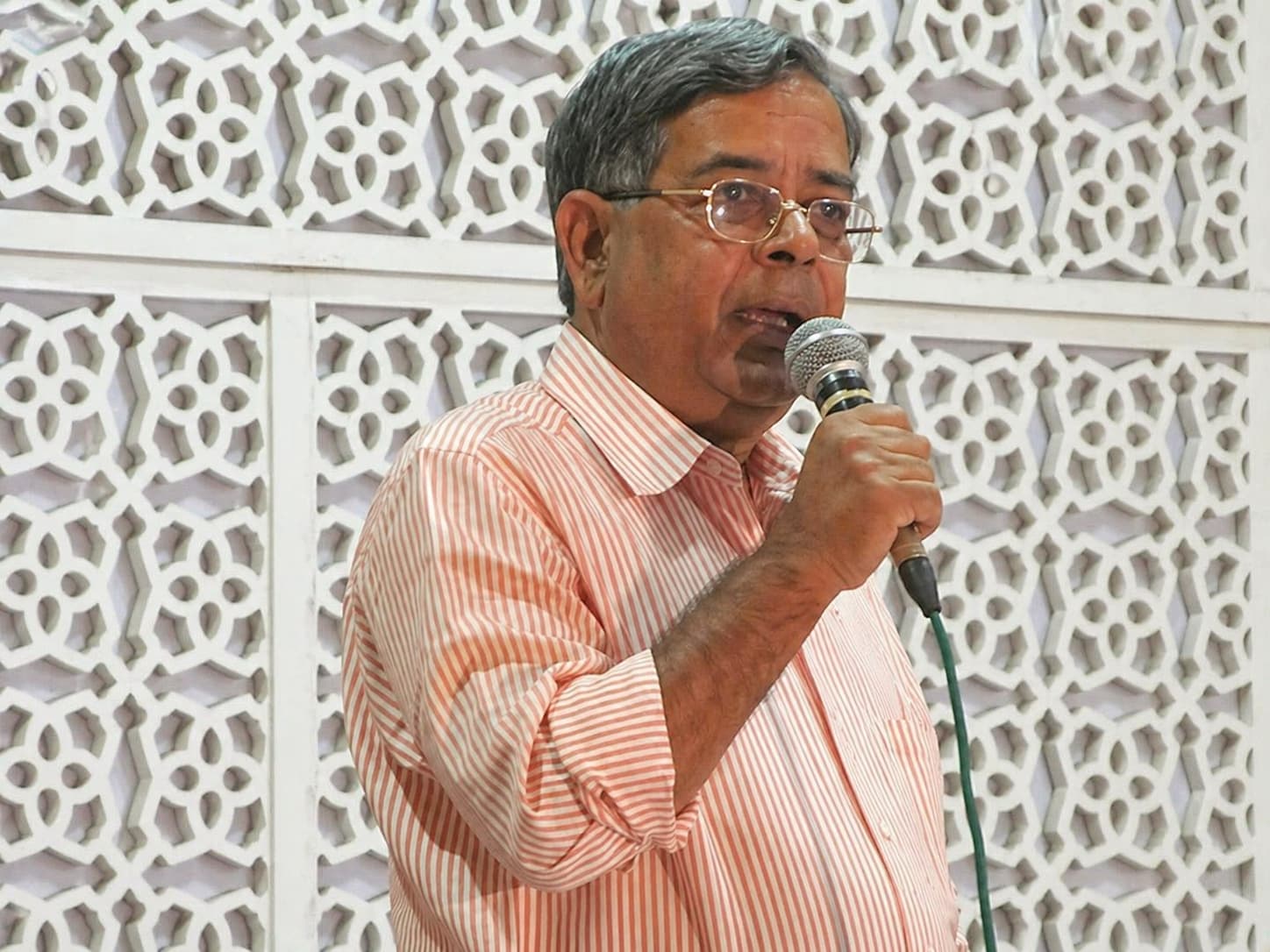
He named his sons after music directors.
When the first boy arrived in 1987, Vivek Deshpande did not reach for a family name or a deity. He reached for Jaidev — the composer whose music, as Vivek put it, transported listeners to “a sublime world of peace and tranquility, a state where one’s conscious submerges with the Almighty.” When the second boy came in 1991, he became Salil, after Salil Chaudhary — the man whose songs had accompanied Vivek through rain and philosophy and sunset since childhood. Two sons, two music directors, one father whose relationship with sound had been as formative as anything that happened in a lecture hall or an operating theatre.
The Books, the Stage, the Bastar Road
Vivek was born on 23 April 1955 in Dhamtari, Chhattisgarh, to Sushila and Dinkar Deshpande. His early childhood moved between Mahasamund and Bhilaigadh, towns in the central Indian interior where his father served the Revenue Department before retiring as a deputy collector in Bhandara.
Both parents carried unusual weight. His father — an alumnus of Hislop and Law College, Nagpur — was an accomplished stage actor who had walked those corridors alongside figures who later became significant in Indian public life. His mother completed her MA in Economics from Nagpur University in 1947, won a gold medal, taught at Lady Amritbai Daga College for women until 1978, and was instrumental in starting the first-degree college in Mehkar. She was a Gandhian, a believer in Sarvodaya, and she bequeathed to Vivek the thing he has been most grateful for: a love of books.
He came to Government Medical College, Nagpur in 1973 — and found, as he put it, that he was among kindred souls. He said: “Honestly, coming into the class of 1973 GMC was one of the most important and beautiful things that have happened to me. In just a few months, I discovered that I was among kindred souls and lost no time in surrounding myself with a large group of friends.”
The Music Society drew him in early. Jayant Pande and Vivek were the vocalists in those years; Shriram Kane and Uday Gupte played the sitar; Rajendra Sarda and Rajendra Phadke the flute; Shashikant Khaire the accordion. They performed at Ambazari Lake, at CP Club, at conferences where they were paid for their appearances. The silsila ran from 1975 to 1987. Vivek had found his voice — literally — in front of boisterous college audiences, and the diffidence he had arrived with dissolved in the noise and warmth of those evenings.
The Male Gynaecologist in 1989
Vivek completed his MD in Obstetrics and Gynaecology at GMC Nagpur, writing his thesis on isoxsuprine in preterm and term pregnancy under the supervision of Dr. Bhattacharya. He chose Ob Gy because he found it, in his words, “interesting and happening.” Surgery, Anaesthesia, and Radiology did not compete.
He worked as a lecturer and associate professor at GMC Nagpur and Dr. Vaishampayan Memorial Government Medical College, Solapur, then resigned in 1989 to start private practice in Nagpur. He was, by his own account, the first qualified male gynaecologist to set up practice in the city — entering a bastion that Nagpur had not yet reconciled itself to sharing with men.
“Nagpur has overcome male infertility — the city has since bred and brought up more than two dozen male Gynaecologists, all of whom are doing excellent work — but in 1989 it was indeed a challenging job for a male gynaecologist to survive. And survive Vivek did.”
He survived and built a practice that lasted four decades. In April 2017, he moved toward teaching, joining JNMC Sawangi as visiting faculty — taking emergency obstetrics off his plate and placing in its stead the transmission of forty years of skill to the next generation. In November 2020, he became Head of the Department at Datta Meghe Medical College, Nagpur, helping establish a new department. He then joined Kingsway Hospital as Senior Consultant, spending two years working with Covid patients. Today, he holds a visiting consultancy at Kingsway and runs a modest consulting practice at Uday Gupte’s polyclinic.
Children, and the Books on the Shelf
On 16 May 1985, Vivek married Neelam — from a family of agriculturists in Telhara, a town northwest of Akola. She had completed her MA and later her M Phil in Economics from Nagpur University before choosing to be a homemaker. Their house is full of books. Va Pu Kale, P.L. Deshpande, Dickens, Dumas, Nevil Shute — the shelves reflect a household where reading was, as in his mother’s home, a practice rather than a pastime.
Jaidev — the elder son, named for the composer — studied electronics engineering and has built a career in data science and AI, earning a BS and B.Statistics from IIT Madras. He is married to Aditi Dani, an advocate on record at the Supreme Court of India. Salil, the younger, read Commerce and completed his CA articleship with PG Joshi and Sons, Nagpur.
Vivek on Covid, having operated and consulted through the worst years: “Working actively during the Covid years has given doctors like us a healthy sense of satisfaction derived from operating in adverse conditions.”
What Remains
The general practice of Indian medicine, in the arc from 1973 to today, moved from generalism toward specialisation, from government service toward private enterprise, from the small-town doctor who did everything toward the narrow super-specialist who does one thing extraordinarily well. Vivek lived that arc without entirely yielding to it. He was a gynaecologist, yes — but he was also a teacher, a singer, a reader, a man who named his sons after the musicians who shaped his inner life, who worked through a pandemic when he could have stepped back, and who still practices, quietly, in a polyclinic run by his batchmate.
The songs he used to hum while walking the corridors of GMC in 1975 — his friends began to ask him to repeat them, to sing particular favourites. He still knows which classmates loved which songs. He still carries the music the way he carries everything: without fuss, without announcement, as part of the fabric of a life built to last.
He named his sons after music directors. Both turned out well.