In May 1982, six weeks after finishing my MD at GMC Nagpur, I arrived at MGIMS as a senior resident in the Department of Medicine. We were a joint family then — my parents, my two brothers, their families, and me — living together in Wardha, on what was Bachelor Road and is now Dr JC Kumarappa Marg, directly opposite Indira Market. The house was eight kilometres from the college. My first assignment was bedside clinics for the 1978 batch, who were heading into their final MBBS examinations that winter, and theory lectures for the 1979 batch.
That summer, Sevagram ran out of water.
Wells dried up. Rivers shrank to muddy trickles. Overhead tanks emptied and taps coughed air. Three hundred students in the hostels could not cook, could not wash, could barely manage. Dr Chhabra, Reader in Obstetrics and Gynaecology, put it plainly: “Water is the most precious thing now. When we have it, I fill every utensil in my kitchen — even a teaspoon.” She could not have said it better.
Dr ML Sharma was Principal of MGIMS then — the post of Dean did not yet exist. He had no choice. He sent the students home to wait for the monsoon. That was May. The rains would not come for four months.
It was 1983. No cell phones. No internet. No way for anxious parents to know whether their children had been sent home officially or quietly suspended. The students, scattered across the country, were bored and restless. They missed the college, the wards, the noise of the hostels. Mostly, they missed each other.
When the rains finally arrived, the students returned — but four months of theory classes and practicals had vanished. Final MBBS exams were fixed for November. Everyone, teachers and students alike, had catching up to do.
Classes began at seven in the morning, an hour earlier than usual. By eight, another lecture followed. From nine to one, students were split between two departments simultaneously — strokes and leaking heart valves in Medicine, then hernias and hydroceles in Surgery. It was relentless, and it needed to be.
Dr OP Gupta headed the Medicine department then, with Dr AP Jain and Dr Ulhas Jajoo as unit heads. They wore discipline on their khadi shirts. They arrived at seven sharp and expected the same from everyone under them. No explanations. No exceptions.
I was assigned lung disorders. Undergraduates. Seven in the morning.
Ask yourself: how many students today would set an alarm for six, forgo their morning tea, and walk across a dark campus to sit through a sixty-minute lecture? In 1983, the MGIMS students did it — and they came almost without fail.
One weekend, I visited my sister in Bhopal. On Monday morning, a seven o’clock class was waiting for me in Wardha.
The train was late.
I sat watching the minutes go, doing the arithmetic no traveller wants to do. Wardha East — Sevagram station, as it is now called — came at 6:35. Twenty-five minutes to class. Home was a kilometre away. No auto-rickshaws in sight.
I ran.
From the station to my house, in the thin early light, in the clothes I had slept in on the train. I washed quickly, pulled on a khadi shirt and trousers, pushed my feet into my Quo Vadis sandals. My mother held out a glass of milk. I was already through the door.
The Priya scooter started on the first kick.
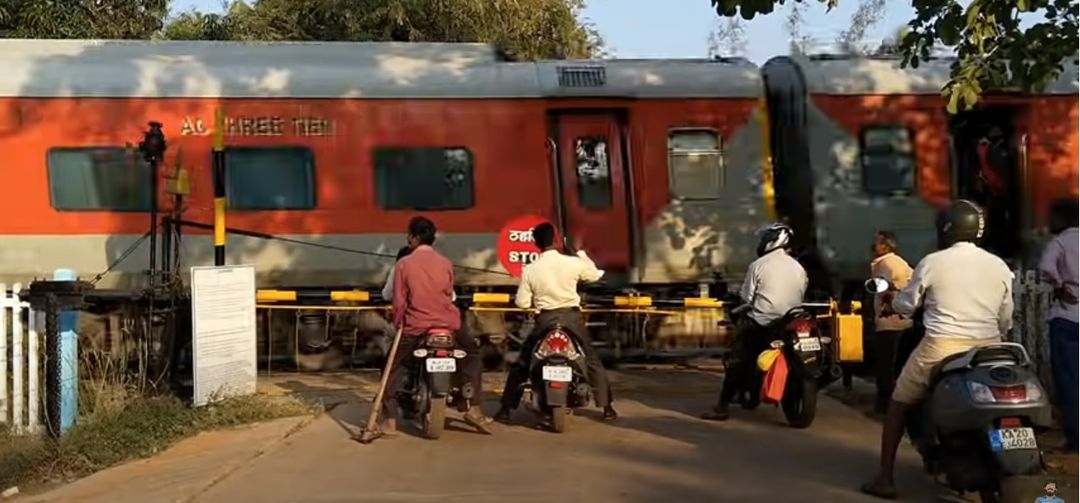
Halfway to Sevagram, the railroad crossing near Wardha East stopped me cold. The Nagpur–Bhusawal passenger train was coming through. The gatekeeper had swung the barrier down, and there was nothing to do but wait.
6:50. Ten minutes to seven.
Then I saw him — a friend, stuck on the other side of the crossing, heading toward Wardha. We read each other’s minds in an instant. We swapped scooters.
His Lambretta was old. It rattled. It groaned. It smelled of oil and better days. I opened the throttle and it protested, then gave in. The needle climbed to eighty. The road was empty, the air sharp, no helmet on my head — helmets were a luxury nobody thought about then. I leaned forward and rode.
I reached the college with seconds to spare. The Lambretta skidded on the muddy ground outside. I shoved it into a rough park, then walked — walked, not ran — into the Adhyayan Mandir, arriving just as the clock struck seven.
The 1979 batch looked up.
I straightened my collar, ran a comb through what remained of my hair, picked up the chalk, and began writing on the blackboard.
It was a small thing. Nobody gave me a medal for it. But standing there, slightly breathless, watching those students settle into their notebooks, I felt something I have never quite forgotten — the quiet, uncomplicated satisfaction of not letting people down.
Sir, myself from 79 batch.We are very much proud to have dedicated teachers like you.
Now a days, this could have been day off best excuse
What a narration
When we grew up that way, it rubbed off. Even now I arrive at my destination at least 15 minutes early even though I know that I would probably be there earlier than the hosts themselves 😊
True. In those days, every minute mattered. Being late for a class, seminar, or clinic was simply not an option, no matter the circumstances.
Felt each moment of your ordeal sir.🙏🌹😊
Proud of you dear S P sir ,I was your student too in 1981 batch , later I did house job in psychiatry under Dr P.K .Joel when he used to be on leave you were my mentor. I still remember your pearl like beautiful hand writing on the black board ..In autobiography Mahatma Gandhi once said when “I saw beautiful handwriting of people in South Africa ,I feel ashamed of my literacy. so good handwriting is a measure of excellent literacy ..congratulations S P sir . 🙏
Thank You! And Dr PK Joel was indeed a very interesting person to work with.
It sounds like a thriller cum adventure. The best was swapping vehicles. Who would think of swapping vehicles from opposite sides to make it to a lecture?What a lifetime of dedication and hardwork it must have been! Hats off to you for remembering the past and nobody would know the story untill it was written in your post. Very interesting read 👌
We simply followed the example set by our role models. It was as simple as that!
What a story! Btw we had droughts in Tamil Nadu (1981.2, 3 possibly) too. and one long holiday because of the lack of water,
Proud of you sir. I am from 90 batch and we have seen shortage of water in summers.
Nd what a turn of event in our life time..everybody studying MBBS Online……how lucky we were
Dr SP Kalantri was so sincere in his work and I m not surprised he was stressed out of being late as he expected the same from his students. I was on his wrong side as I was a happy go lucky type, not the one like by my Boss.
OMG! 😆
Such an exciting narration! Sir, you are amazing with your descriptions. Loved reading it.
Sir, we loved attending your classes and clinics. You demonstrated clinical signs so well; we will never forget them. Thank you, Sir, for building a strong foundation in our basics.
Sirji, I was fortunate to be part of history by attending your morning lecture that day. Later, during postgraduation, I was groomed in the art of clinical medicine. Your teaching has remained an integral part of my practice.
I am grateful to you for making me read journals and for transforming our journey in medicine. Thank you, Sirji.
Dr. Haresh Sidhwa
1979 batch
Sir, that era will never come again—neither the students nor the teachers.
Dedication to learning and teaching.
A salute to this unique feature of Sevagram.
Down memory lane, thank you for reviving those bittersweet memories of our stay in Sevagram. I was a participant in the scooter swap program 😊, as you would almost always find someone you knew on the other side of the gate.
The other memory is of the acute water shortage in 1983. Even though my house was in Vivekanand Block, my parents had gone to the USA to meet my sister, so I stayed in the hostel, where we were given two buckets of water and told to do whatever we could with them 😄
A remarkable feat indeed—considering the judicious use of resources and the thinking on your feet (to borrow the idiom). And no medals for being punctual!
Another gem from the Sevagram chronicles.
Rare breed sir, So proud of you sir .I think Sir word bana hi aap jaison ke liye hai.
Dedication and discipline of a different age
The girls’ hostel was a desert. Between seven and eight in the morning, a lone water tanker would rumble to the front door. We were rationed exactly one bucket for the day. There were no coolers then, let alone air conditioning. To survive my first-floor room, I soaked my curtains in my precious ration of water just to make the air breathable enough to study.
By night, we retreated to the hostel terrace. One dawn, looking across to the boys’ quarters, we spotted two legs pointing stubbornly at the sky — Munish Kumar Sharma was doing a Shirshasana. It was a gruelling time. Yet I can still see the evening sky and feel the warmth of a coffee mug as we sat chatting, waiting for the exams to end. My roll number was 63. On the final day, the Three Musketeers — Vidyadhar Bangal, Yashbir Diwan, and I — walked back to the hostel under the orange glow of a setting sun, finally free.
The taps were bone-dry. A small tanker, pulled by a rusty tractor, arrived every other day. We boys would line up for our two-bucket quota. I learned to bathe with a quarter of a bucket; the rest had to last forty-eight hours for the essentials. We even gave each other instructions on how to use the toilets to save every drop. It was oppressive. I remember writing one exam paper in a hall with no power — no fans, just the sound of pens scratching in the stifling heat.
We used to spread wet sheets on the floor and lie on them to study. It was the only way to keep the brain from boiling