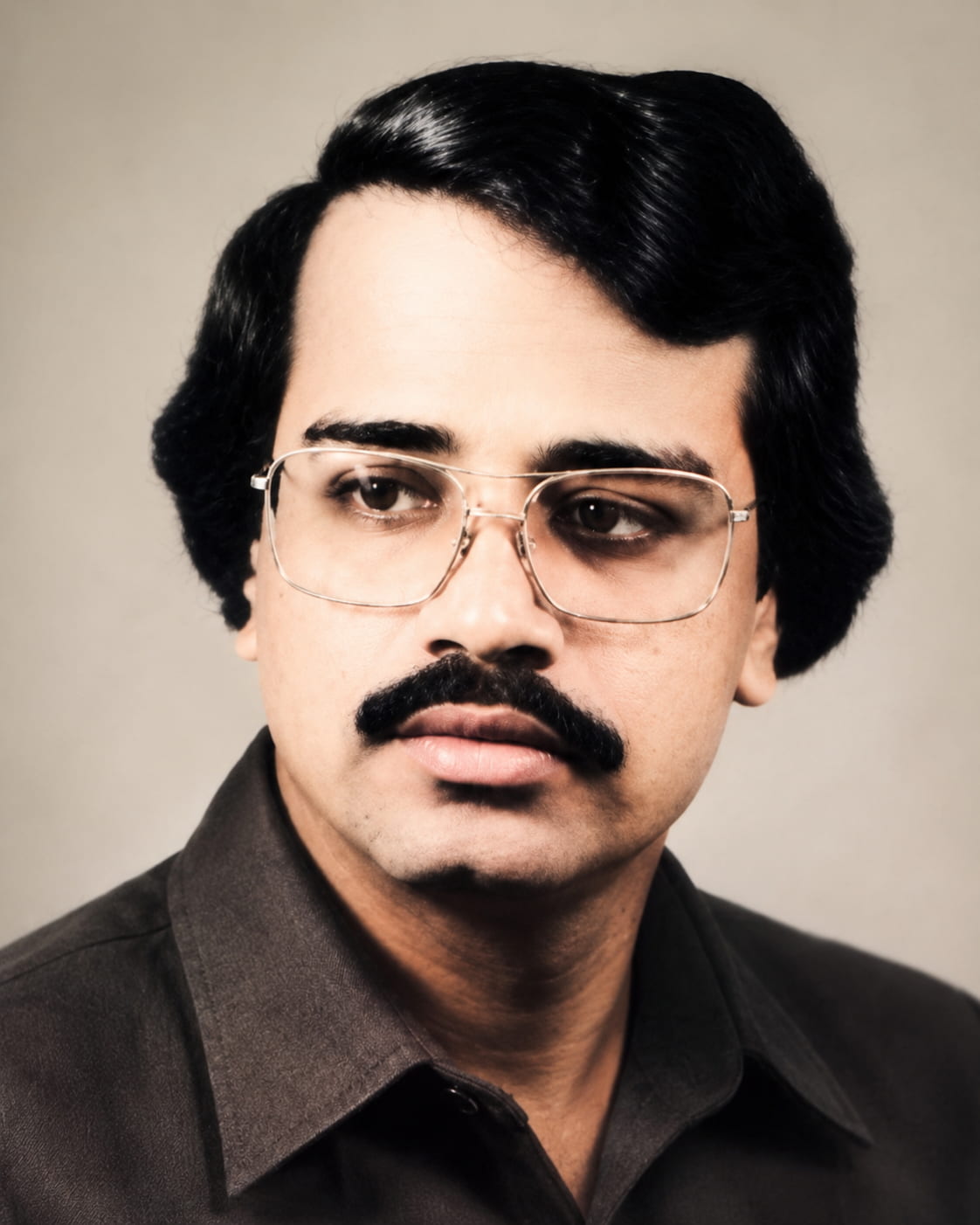
Nandkishor Taori—known to everyone simply as Nandu—had a habit that patients in Malkapur never forgot. No matter the hour, if someone knocked on his door, he went. Midnight fever, a child gasping for breath, an anxious family waiting outside in the dark—he arrived without irritation, drama, or delay. Years after his death, people still remembered less the medicines he prescribed than the reassurance of his presence. For them, healing began when Nandu walked in.
That instinct for service had deep roots. Born in Borala, near Jalgaon Jamod, Nandu lost his father at the age of three. His childhood unfolded in conditions of restraint and discipline, largely under the care of relatives in Danapur. There was little room for indulgence or self-pity. Scarcity taught him endurance; loss taught him responsibility. The hardships of those years did not harden him. They gave him steadiness.
He completed his early education in the Buldhana region and came to Jankidevi Bajaj Science College, Wardha, before entering Government Medical College, Nagpur, in 1973. Like many students from small towns, he arrived with limited means but enormous determination. During his first year, he stayed at Aruna Lodge in Dhantoli with Ramesh Mundle and Sudhakar Sawdatkar. A few months later, he shifted to Hanuman Nagar, sharing accommodation with Narayan Dongre before eventually moving into the hostel.
The Saptrishi of the Soil
At GMC, Nandu became part of a close circle of friends later known as the “Saptrishi”—the seven sages. The group included Vijay Kherde, Nandkishor Salampuria, Makhanlal Gupta, Indra Ostwal, Vrajlal Patel, Murtuza Akhtar, and Nandu himself. Most came from the districts of Akola and Buldhana. They carried the anxieties of first-generation professional students, depended heavily on one another, and forged friendships that lasted a lifetime.
Within the group, Nandu emerged as its calm and articulate centre. He had the gift of clarity. When friends worried about money, exams, or the uncertainty of the future, he reduced the problem to its essentials: one could spend life blaming circumstances, or one could move forward despite them. That practical wisdom stayed with many of his classmates long after graduation.
His internship exposed him to both urban and rural medicine. He worked at the District Hospital in Wardha with Prabhakar Patil and Narayan Dongre, and later at the Primary Health Centre in Kondhali alongside Nandkishor Chandak, Omprakash Bohra, and Laxmikant Rathi. Those postings grounded him in the realities of small-town practice and strengthened his resolve to return to his own region.
In 1980, he established his practice in Malkapur. Around the same time, several of his close friends also returned to their hometowns to begin medical practice—Makhanlal Gupta in Akola and Ajit Jadhao in Jalgaon Jamod among them. It was less a coordinated plan than a shared instinct: to carry their training back to the communities that had shaped them.
Over the years, Nandu developed an unusual professional identity. While teaching homeopathy at a local college, he became deeply interested in the discipline. Like his classmate Waqar Mohiuddin Taji, he was drawn to its emphasis on individualisation. Yet he never abandoned allopathy. Instead, he evolved a blended practice—using allopathy for acute illness and homeopathy for chronic problems. In smaller towns, where rigid boundaries mattered less than trust and relief, patients responded warmly to this pragmatic approach.
But medicine was only one part of his gift. He connected easily with people. He spoke well, anchored family and community events with ease, and had a natural instinct for language and tone. His daughter Roshani would later recall that he was often the preferred master of ceremonies at weddings and public functions because he could speak with warmth, humour, and precision. Friends remember the same quality in quieter settings: conversations with him carried clarity without sharpness, conviction without arrogance.
At the core of his life lay a simple philosophy: to live in the moment. He carried this quietly, drawing from the teachings of the Bhagavad Gita, and letting it guide both his work and his way of being.
कर्मण्येवाधिकारस्ते मा फलेषु कदाचन ।
मा कर्मफलहेतुर्भूर्मा ते सङ्गोऽस्त्वकर्मणि ॥
karmanye vadhikaraste ma phaleshu kadachana |
ma karmaphalaheturbhurma te sangostvakarmani ||
You have a right to perform your prescribed duties, but you are not entitled to the fruits of your actions. Never consider yourself to be the cause of the results of your activities, nor be attached to inaction.
— Bhagavad Gita, Chapter 2, Verse 47
The Allopath’s Turn Toward the Globule
The defining paradox of Nandu’s professional life was his “dual practice.” At a time when many of his classmates leaned deeper into the expanding technologies of allopathy, he found himself drawn to homeopathy while teaching at a local college. Like his classmate Waqar Taji, he began to question the limits of broad generalisations and to appreciate the careful individualisation that homeopathy demanded.
Yet he did not turn away from his formal training. Instead, he shaped a hybrid practice—turning to the decisiveness of allopathy for acute illness, and to the gentler, individualised approach of homeopathy for chronic conditions. It was a thoughtful balance rather than a compromise, and it earned him a formidable reputation in Malkapur.
He understood people as much as he understood disease. Whether called to see a patient late at night or standing before a gathering as master of ceremonies at a community wedding, he read the room with ease. Words came naturally to him, but more importantly, they landed well. He spoke with clarity, adjusted his tone to the moment, and carried an instinctive sense of how to connect.
The Premature Silence
In February 1998, at the age of forty-four, Nandu developed sudden chest pain. Realising the gravity of the situation, he called his close friend and classmate Sudhakar Sawdatkar in Buldhana. But events moved too quickly. Before effective medical help could arrive, he died in a local hospital. The physician who had answered countless emergency calls could not be saved from his own final emergency.Nandu Taori lived by a simple, steady principle drawn from the Bhagavad Gita: focus on the work, not the reward. From a boy in Borala to a trusted physician in Malkapur, he shaped his life with resolve rather than circumstance. Those who remember him do not speak first of his degrees or his methods. They recall something more enduring—a doctor who showed up, without fail, at any hour of the day or night, and in doing so, completed the circle of service he had begun as a student.
His death left a profound void in his family and among his friends. Yet the life he built continued through those he nurtured. He is survived by his wife, Lata, and their three children. Roshani went on to become a paediatric neurologist in the United States; Rucha and Shaheen built successful careers in engineering. His children often felt that, despite his early death, his guidance remained with them—quietly shaping their choices and resilience.
Nandu Taori’s life never sought spectacle. It moved through duty, friendship, service, and constancy. From a fatherless boy in Borala to a trusted physician in Malkapur, he carried forward one enduring belief: when people need you, you show up. For those who knew him, that remains his truest memorial.
Years later, GMC continued to echo through the family in unexpected ways. Roshani, who later trained in paediatrics at KEM Hospital, Mumbai, still remembered being examined in surgery by Dr. Murtuza Akhtar—her father’s old classmate from the Saptrishi circle.
During her own admission to GMC, she was allotted roll number 191; only much later did she realise that her father’s roll number had been 192. Had she known then, she recalled with amusement and affection, she would have “done anything” to exchange it.
For the Taori family, GMC was never merely a college. It remained an emotional inheritance.